A moisture event begins
Wind-driven rain, a plumbing leak, condensate issue, roof history, or elevated indoor humidity introduces moisture.
 T.A.P. INSPECTIONSTRUSTWORTHY • ACCURATE • PROFESSIONAL
Marco Island • Licensed Mold Assessor
If you suspect mold in a Marco Island home or condo, start with a professional mold inspection that investigates moisture conditions first. Testing and sampling are then selected only when they can answer a useful question.
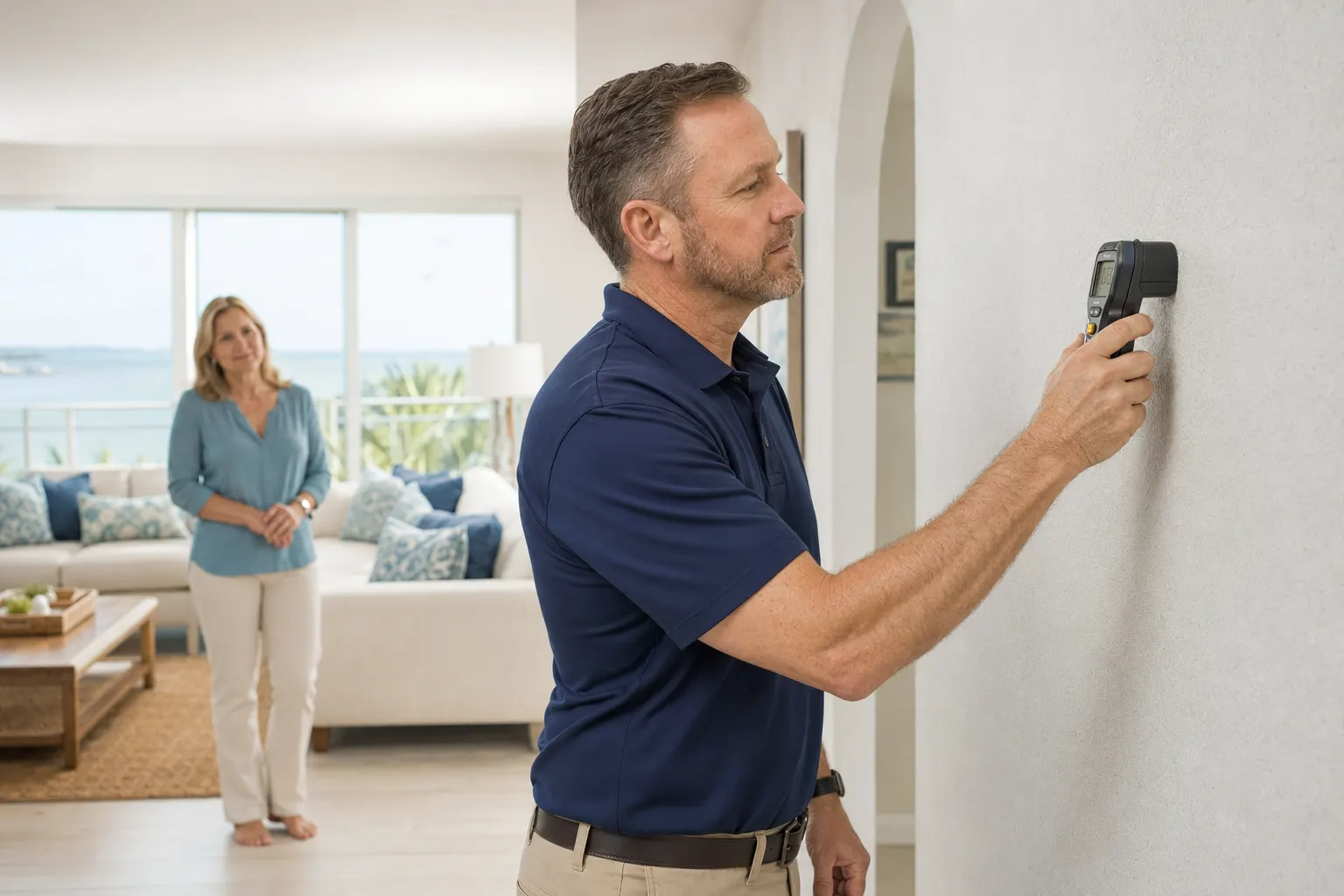
MOLD INSPECTION OR MOLD ASSESSMENT?
T.A.P. uses both terms clearly: the appointment includes a professional inspection of accessible building and moisture conditions, while the licensed mold assessment documents findings, determines whether sampling is appropriate, and explains the next steps.
WHY LOCAL CONTEXT MATTERS
Coastal rain, seasonal vacancy, cold air-conditioning surfaces, exterior openings, plumbing, and shared condominium assemblies can create very different investigation paths. The mold inspection follows the evidence backward toward the likely moisture source, with testing used purposefully when appropriate.
Wind-driven rain, a plumbing leak, condensate issue, roof history, or elevated indoor humidity introduces moisture.
Drywall, baseboards, cabinets, flooring edges, insulation, and wall transitions can stay damp after surfaces appear dry.
Odor, staining, condensation, elevated readings, or recurring symptoms in one area help define the investigation.
Visual observations, moisture data, property history, and purposeful sampling are interpreted together.
COMMON MARCO ISLAND CALLS
A good assessment is not a checklist performed the same way every time. The concern, building type, history, and accessible evidence determine the scope.
The assessment considers vacancy duration, thermostat settings, indoor humidity, air movement, HVAC operation, closets, furnishings, and exterior-wall conditions.
We look at the relationship between the opening, track, sealants, wall transition, baseboard, flooring edge, and the timing of wind-driven rain.
Settling plates alone cannot explain the building. The assessment reviews accessible registers, nearby surfaces, humidity, condensation clues, condensate components, and room patterns.
Past water paths, drying history, repairs, accessible finishes, moisture readings, and affected-room boundaries help determine whether further evaluation is warranted.
PROPERTY-SPECIFIC ASSESSMENT
The inspection scope stays visual and non-invasive, but the building questions change with ownership boundaries, exterior assemblies, mechanical systems, and the path water may have taken.
CONDOMINIUMS
HOMES & WATERFRONT PROPERTIES
WHAT YOU RECEIVE
When sampling is appropriate, laboratory results are reviewed alongside the property observations and moisture information so the findings have context.
LOCAL COVERAGE
Old Marco • Tigertail • Hideaway Beach • The Estates • South End • Gulf-front condominiums • Canal neighborhoods • Commercial properties
MARCO ISLAND QUESTIONS
These answers are specific to the way mold and moisture concerns are commonly approached in island homes and condominiums.
Consumers often use the term mold inspector, while Florida licenses individuals who perform professional mold assessment as mold assessors. T.A.P. Inspections provides assessment through Florida Mold Assessor license MRSA2395.
No. Sampling should answer a defined question. The selected service, visible conditions, moisture history, property layout, and assessment plan determine whether air or surface samples are appropriate.
Growth on a settling plate shows that organisms capable of growing on that medium were present, but it does not locate the moisture source, establish building conditions, or replace a professional assessment and properly interpreted laboratory sampling.
The assessment is visual and non-invasive. Finished assemblies and equipment are not dismantled. When concealed conditions remain a concern, the report may recommend controlled access or further evaluation by an appropriate qualified professional.
Yes, the accessible unit can be assessed and observations documented. Building-envelope, roof, common piping, adjacent-unit, or association-controlled areas require permission, access, and sometimes a separately defined scope.
No. Assessment and remediation are kept independent. Florida rules also restrict an assessor from performing remediation on a structure the assessor or assessor’s company assessed within the applicable statutory period.
It is a separate evaluation after remediation to review visible conditions, moisture status, and any agreed sampling or protocol criteria before the project is considered complete.
MARCO ISLAND MOLD INSPECTION & TESTING
Begin with an independent evaluation of the property conditions, moisture history, and evidence.